Carolyn Copper - Photographer
Copper Range LLC
Connecting you with nature

Life is Better With Birds
It seems birds have always delighted people all over the world. They’re beautiful, powerful, engaging and make a lot of us very curious. Bird-watching or birding – the observing of birds either for fun, science applications, or other professional purposes, is an incredibly popular activity and it’s one of the fastest growing outdoor activities. It’s fair to say that dedicated wildlife photographers that include birds in their craft are also birders – me included. I’ve learned a lot from birders!
In my newest podcast I’m excited to talk with Jay Sheppard who had a career as an ornithologist with the US Fish & Wildlife Service; is a fellow in the American Ornithological Society; has birded in all 50 states; and more recently has been leading tours to observe short-eared owls on a Maryland property slated for commercial development. That’s how I came to know Jay.
Jay is certainly a birder, but he’s also a bird scientist and dedicated conservationist. In addition to his 23-year career with the US Fish & Wildlife Service, in retirement, Jay wrote a nearly 500-page life-study of the LeConte’s Thrasher – a bird found in the desert southwest. Jay’s study was published by the organization of Western Field Ornithologists, and can be purchased from them or it’s also available on Amazon. I’m excited to have Jay on the podcast today – listen in – to hear from someone who has dedicated his life to the study and conservation of birds and their habitats. He’s seen a lot and done a lot.
Here’s the questions Jay answered in my newest podcast (episode now archived!)
- You've been watching, studying, and following birds for decades, and you had a career focused on birds. What interests you most about birds?
- You’ve been organizing short-eared owl tours at the Konterra, Maryland private property for a few years. I’ve been on these tours and loved it. I have a few questions about this.
- First, how do you describe Konterra?
- How did you discover Konterra, Maryland?
- How many people have joined the Konterra tours?
- Do you expect Konterra will be developed some day?
- What makes the Konterra property good habitat for the birds and other wildlife that live and migrate there?
- What can those of us who benefit from birding and bird photography do to support the Konterra habitat?
- Do you have a favorite bird?
- We’re coming into winter season. You have a helpful post on your Facebook page about laying down a tarp when it snows to create a bare patch of grass for birds. Can you describe this and why it’s helpful for birds, as well as birders?
- You’ve birded in all 50 states and Canada which means you’ve seen some amazing bird life. What’s the most unusual or unexpected encounter you’ve had?
- What tips would you give new birders?
- What tips would you give seasoned birders?
Sources and More Information:
https://www.facebook.com/birders/
https://americanornithology.org/
https://www.birdwatching.com/birdingfaq.html
https://www.nationalgeographic.com/family/article/getting-started-birder
https://en.wikipedia.org/wiki/Birdwatching
https://www.birdwatchersdigest.com/bwdsite/learn/top10/top-10-things-bird-watchers-need.php
https://www.audubon.org/birding/how-to-start-birding
https://www.amazon.com/Biology-Desert-Apparition-LeContes-Toxostoma-ebook/dp/B07R7FQDNJ
https://ebird.org/profile/MTgwODE2/world
The Power to Make Humans Feel Human, In an Inhuman World
The power to make humans feel human, in an inhuman world. This Veteran’s Day I’m thinking about war, what war does to people, and how animals of almost every kind, and particularly horses, have helped many veterans, first responders, and others, manage the trauma and blunt emotion that often follows war.

Just last week in Washington DC, the funeral of General Colin Powell was held at the Washington National Cathedral. I watched the funeral on TV. Watching and listening to the funeral reminded me of so many things because Colin Powell was at the height of his military and government career when I was early in my federal government career here in Washington, DC.
In that career, I had a position in the government where I was part of a project that performed clear-eyed oversight of military programs and activities. One of those activities was Operation Desert Storm (aka the Gulf War), a military campaign in the early 1990’s to expel Iraqi military forces from Kuwait. At the time, Colin Powell was the Chairman of the Joint Chiefs of Staff. I learned a lot about the technical and strategic aspects of war during those years I worked on the Operation Desert Storm project. I also learned a lot about what war does to humans. It’s an immeasurable gift that the quiet love and acceptance of animals can help heal very deep human wounds and trauma.
There are many terrific organizations that use horses to help heal and equip veterans for life after traumatic events and difficulties. I list a few below, along with other resources.
Sources and Information:
https://www.warhorsesforveterans.org/
https://warhorsesforheroes.org/
https://www.vfw.org/media-and-events/latest-releases/archives/2018/9/war-horses-for-veterans
It Takes All of Us
For me, one of the most difficult things about wildlife photography is probably not what you think. It’s not the technical skill, research required, strength, discipline, travel to many and varied places, or exhibiting and selling work that’s hardest. Of course, those things have challenges, and don’t come easy; but what I find most challenging is witnessing other photographers – professionals, amateurs, hobbyists -- and other outdoor enthusiasts -- engaging in what’s come to be understood as unethical wildlife photography. This doesn’t happen a lot, but it does happen; and even things that occur in small amounts can do serious harm.
Here’s what’s so challenging. We have a lot of people talking about unethical wildlife photography, including popular wildlife photographers and prominent organizations issuing very well-crafted and thought-out guidelines and policies on the dos and don’ts of wildlife photography. But we lack lucid, concrete, steps that we can take when we find ourselves right next to, or in the company of people engaging in unethical, or even dangerous behavior, while photographing wildlife. I’ve been thinking a lot about this recently because in my region of the US, we’re heading into owl season, and put simply, owls are keenly sought after by wildlife photographers, birders, and other wildlife lovers. In the last couple of years, I’ve had several encounters with other wildlife photographers, birders, and others, who were either, (1) willfully ignoring and by-passing clear protections to prevent people from getting too close to nesting owls; or (2) were not aware of the potential consequences of creating noisy, crowded conditions while photographing wildlife.

You might ask – Isn’t there a place where such unethical people and behaviors can be reported so these actions can be stopped and prevented? Well, in most circumstances, there is no such place or authority. Except for the few people who report what they believe is unethical behavior on Facebook birding groups or other social media groups, there are essentially no consequences to humans who choose to intentionally or unintentionally engage in unethical, disruptive and harmful wildlife photography or wildlife watching.That’s a hard truth, and completely unjust to the wildlife we love.
One of the things I see a lot in discussions about unethical wildlife photographers is a recounting and social-media, or email sharing, of an ethics policy from an authoritative source that states and describes the wrongs of unethical photography. There are a few of these ethics policies out there, and I’m grateful to the organizations that have invested the time, resources, and thought into developing ethics policies. Since I belong to and follow a few birding groups, the ethics policy I often see distributed among birders is the American Birding Association (ABA) Code of Ethics. It has three main provisions along with clarifying points on each of these provisions. The guiding provisions are:
- Respect and promote birds and their environment.
- Respect and promote the birding community and its individual members.
- Respect and promote the law and the rights of others.
There are also a few guidelines for ethical wildlife photography. For example, Principles of Ethical Field Practices, by the North American Nature Photography Association (NANPA) and Audubon’s Guide to Ethical Bird Photography and Videography. NANPA’s guide emphasizes three ethical field practices, which align closely with ABA’s. A useful and important feature of NANPA’s ethics guide is its emphasis on photographers being knowledgeable and having knowledge and awareness of what they’re doing, where they’re going and others around them. For readability, I added “(have)” to each of the three NANPA principles below.
- (have) KNOWLEDGE OF SUBJECT AND PLACE
- (have) KNOWLEDGE OF RULES AND LAWS
- (have) EXPERTISE AND RESPONSIBILITIES
Ethics policies and codes like these are essential, educational tools and resources that I believe make a difference. But what happens when you’re out in the field and you witness something unethical and inappropriate? These real-world scenarios aren’t covered by any of the ethics policies or guidelines I’ve reviewed. Not everyone wants to be that person that tells a stranger, to their face, they’re doing something wrong. In fact, many people avoid these kinds of situations because they don’t feel equipped to manage the situation effectively. There’s understandable fear and anxiety about these kinds of encounters with our fellow humans. Alternatively, there are those that may speak up when they see an unethical photographer in action, but who may come off offensive and harsh because the only way they’ve been equipped to handle these situations is by reminding the offender that they’re “breaking rules.”
In winter 2020-21, at the height of pandemic closures and staying-at-home in the United States, I had an encounter with a visitor who was among the thousands to visit the Chesapeake & Ohio Canal National Historical Park in Maryland to get a glimpse of the male painted bunting that had shown up in our area. The visitor was standing along with me and many others who were waiting for the bunting to appear when she started using a bird sounds app on her phone. There were several others nearby who saw and heard what I did. The disappointed looks on their faces signaled that they might have believed this was wrong, but no one said a word. Using bird call recordings isn’t permitted in National Parks because, according to the National Park Service, “mimicking animal sounds is considered harassment, which is illegal.” (https://www.nps.gov/subjects/watchingwildlife/gear.htm ).
At that time, I didn’t know that bird calling apps and sounds weren’t permitted in National Parks. By the way, many or all of the National Wildlife Refuges also prohibit bird calling. But here’s what I did know -- bird calling, under those conditions, was potentially harmful to this male painted bunting. Birds have excellent hearing and when they hear what they think is another bird in the area it can raise alarms, cause them to flee the area, cause them to search out the bird, and generally cause them to use up valuable energy. Further, it was the middle of winter; it was cold, food was scarce and the painting bunting was hundreds of miles from its warmer, and normal, winter range. This rare vagrant painted bunting was already under stress from many factors, and using bird calls just so the visitor could get a photo, just wasn’t a good choice. I told the visitor that the bird calling app was likely to add to the bunting’s stress. The visitor appeared to ignore me, continued to play the app for a few more seconds, eventually turned it off and then left the area.
What if I had known the National Park’s position and policy that bird calling sounds and apps are considered wildlife harassment and therefore illegal? I could just have led with that and told this visitor they were a rule breaker – period – done -- I can now go back to what I was doing. Alternatively, as advised by NANPA’s ethics guidelines I could: “Report inappropriate behavior to proper authorities. Don’t argue with those who don’t care; report them.” Both of these options are not unreasonable, and importantly, there could be situations where these are the only or best options. But, reporting someone, or getting in their face to tell them they broke a rule aren’t the only options. Also, these approaches get in the way of one critical thing – educating others on the impact they’re having. Many people actually don’t know that things like bird calling, feeding wild animals, or getting too close or being too loud has consequences and can harm wildlife.
This is where a communication technique called “Authority of the Resource (ART)” can be invaluable because it supports effective and respectful interactions. This technique is embedded in the “Leave No Trace” conservation principles, which have been broadly adopted by US National Parks and other recreation or public land areas.
ART was laid out in 1990 by Dr. George Wallace, a professor specializing in human dimensions of natural resources at Colorado State University. He believed those who cause impacts in natural areas do so because they’re (a) unskilled; (b) uninformed; (c) careless; or (d) unintentional. Dr. Wallace observed a variety of law enforcement rangers in the field. He noted that rangers who incorporated an educational message in their interactions were more likely to successfully influence a visitor’s outdoor ethic.
A first step in using ART is recognizing that people who visit wild places, go hiking, birding, or photographing wildlife, aren’t usually there to cause harm. Should harm occur though, if we can clearly explain the impact their actions had, the consequences of the impact, and help them understand the preferred alternative, we can be successful in peacefully and respectfully changing behavior.
There’s a good deal of information on the internet about ART and some organizations offer training. Search your favorite web browser with “Authority of the Resource.” Below, I provided a 4-step summary of how an interaction could proceed; and I use the experience I described earlier, witnessing a birder using a bird calling app in a National Park. One recommendation is that when you start your conversation, stand shoulder-to-shoulder (vs. face-to-face) with the person you’re addressing.
1. Introduce yourself and take a moment for ice breaking conversation.
Example: Hi, I’m Carolyn. I’m here like so many others to photograph this amazing bird. Is this your first visit out to see the painted bunting?
2. Give an objective description of the undesirable behavior observed.
Example: I noticed you were playing bird calls that sound like a painted bunting.
3. Reveal/"interpret" the implications of the undesirable behavior.Focus on how the behavior impacts to the resource or the experience of others.
Example: This little bunting is really a survivor out here. There’s a lot of people out here, it’s cold, and food can’t be easy to find out here. Those things put a lot of stress on this little bird. Playing bird sounds can actually add to that stress. These birds are always on alert. The bunting will pay attention to the call and might even fly out from where it’s trying to rest, stay warm, or find food.
4. Describe the desired behavior. Communicate appreciation for the resource and model desired behavior when possible. Describe agency norm when appropriate.
Example: I’m really excited to see this bunting too. We all want to see this bird make it out here and not make things harder for it. It just takes patience. I feel like I should also let you know that it’s actually illegal to use bird call recordings in National Parks. The National Park system considers it harassment. You can find that on their web site, along with other rules for visiting the Parks.
As we wildlife photographers, birders, nature lovers, and other outdoor enthusiasts head into owl season, it’s not a bad idea to anticipate that we might encounter a few cases of photographers, birders, and enthusiasts, at all levels of expertise and skill, engaging in behaviors that put our wildlife and birds at risk. Before you head out, refresh your memory on the ART technique, imagine the scenarios where it might be used and practice how to intervene effectively. You’ll be doing something great for the wildlife we love so much.
It takes all of us.


Sources and More Information:
https://www.mass.gov/service-details/wildlife-viewing-ethics
https://www.washingtonpost.com/dc-md-va/2021/01/03/painted-bunting-great-falls-bird-watchers/
https://www.thespruce.com/ethics-of-bird-calls-386683
https://www.nps.gov/subjects/watchingwildlife/gear.htm
https://lnt.org/authority-of-the-resource/
https://www.nps.gov/articles/leave-no-trace-seven-principles.htm
https://sc.audubon.org/news/using-bird-calls-ethically
If a butterfly lands on you it’s probably tasting you…. And more interesting truths.
I’ve never set out to intentionally photograph butterflies, but the places I travel to intentionally photograph other species and landscapes, at certain times of year, are often the same places I encounter amazing butterflies. Most of us learned something about butterflies during elementary school. We may even remember a bit about the astonishing lifecycle and transformation of butterflies. I remember some of what I learned about butterflies, but since I come across so many different butterflies doing all sorts of interesting behaviors – that I don’t remember learning about – I was curious to brush up on my butterfly facts. I’m glad I did.

Butterflies are beautiful and there’s a lot of them. There are about 28,000 butterfly species worldwide. Butterflies are found in all types of environments but most species are found in tropical areas, especially tropical rainforests. We should enjoy them while we can. With some exceptions, the average lifespan of an adult butterfly is roughly three to four weeks. Some butterflies, like the North American Monarch, can survive for nearly eight months.
Wings That Wow
One of the most eye-catching things about butterflies is their wings, and specifically, the color of their wings. Butterflies have scaled wings with colorful designs unique to each species. Those wings make butterflies good fliers. It’s a good thing that they’re good fliers because many species of butterflies migrate. Although butterfly migration isn’t well understood, some species like the Painted Lady, the Red Admiral, and the Common Buckeye are known to migrate a few hundred miles, but others like some Monarchs migrate thousands of miles. The monarch is the only butterfly known to make a two-way migration as birds do.
 Buckeye Butterfly
 Painted Lady Butterfly
The fastest butterflies can fly at about 30 mph (about 48 km/h) or faster. Slow flying butterflies fly about 5 mph (about 8 km/h). It may look like butterflies have two wings but all butterflies have four wings – one forewing on each side closest to the head; and one hindwing on both sides in the rear.

Besides being eye-catching to us humans, butterfly wings also have an important optics function to other butterflies, and other species. The colors and patterns on a butterfly’s wings help it communicate and attract other butterflies of its species, and warn, camouflage, or distract it from predators. In the case of poisonous butterflies, like the Monarch, the wings store toxins. Just know that you would have to eat Monarchs to be exposed to the toxins. Hopefully no one you know is eating Monarch butterflies!!
Have you ever wondered what happens to butterflies when it rains? How is it that they just don’t disintegrate or get completely destroyed in a summer downpour? Butterflies take shelter, or roost, in or under plants, trees, leaves or any other area including human-made structures where they can stay dry, warm, and hopefully away from predators. Taking shelter obviously goes a long way for protection but research shows that butterflies have a layer of wax on their wings that repels water. Not only that but they also have “microscale bumps” on their wings that serve to break up and disperse water droplets. In short, when a water drop hits the surface of butterfly wings, it ripples and spreads.
Butterflies are cold-blooded so that means their body temperature isn’t stable but changes with the environmental temperature. One main reason that we typically only see butterflies on warmer days is because they can fly as long as the air is between 60°-108° F (15.5 – 42.2 C), but temperatures between 82°-100° F (27.7 - 37.7 C) are best. If the temperature drops too low, butterflies might bask in a sunny spot with wings spread out to soak up the sun's heat.

Butterflies can’t survive winter conditions in an active state. But they may be able to survive cold weather by hibernating in protected locations. They may use the peeling bark of trees, plants, logs or old fences, or the eaves of houses or buildings as their overwintering sites. They may hibernate at any stage (egg, caterpillar, chrysalis or adult) but generally each species of butterfly is dormant in only one stage. With that said, If the weather begins changing some species migrate in search of sunshine.
Again, because they’re cold-blooded, when the outdoor temperature gets too warm, butterflies may head for shade or for cool areas like puddles. Some species will gather at shallow mud puddles or wet sandy areas, sipping mineral-rich water.

The Transformation
One butterfly fact I didn’t forget from my elementary school days is the metamorphosis of butterflies – the caterpillar (larva); the chrysalis (pupa); and then the butterfly (adult). Well, it’s a little more complicated. A butterfly starts its life as an egg, often laid on a leaf. The female butterfly attaches the eggs to leaves or stems of plants that will also serve as a suitable food source for the larvae (caterpillars) when they hatch. Caterpillars are very particular about what they eat, so the female lays her eggs only on certain plants. Caterpillars don't move much and may spend their entire lives on the same plant or even the same leaf, so it needs to be the right leaf!
The female butterfly can recognize the right plant species by its leaf color and shape. Just to be sure, she may beat on the leaf with her feet. This scratches the leaf surface, causing a characteristic plant odor to be released. Once she’s sure she found the correct plant species, she lays her eggs. The eggs get fertilized as they’re being laid with the sperm stored in the female’s body since mating. A sticky substance produced by the female enables the eggs to stick where ever she lays them, either on the underside of a leaf or on a stem. Male butterflies search for and pursue female mates. As with many species, mating involves some courtship dances and cool maneuvers designed to win the attention of that special lady butterfly.
 Passion - Gulf Frittilary Butterflies on Passion Flower
The larva (caterpillar) hatches from the laid egg and then eats almost constantly. This constant eating means the caterpillar increases up to several thousand times in size before pupating (turning into chrysalis); it also means the caterpillar molts (loses its old skin) many times as it’s growing. Molting occurs because the outer skin (exoskeleton) doesn’t grow as the caterpillar enlarges and grows. A caterpillar may go through as many as four to five molts before it becomes a pupa.
When the eating is done, it’s time to rest and turn into a pupa (chrysalis). The caterpillar attaches itself to a twig, a wall or some other support and the exoskeleton splits open to reveal the chrysalis. The chrysalis hangs down like a small sack until the transformation to butterfly is complete. Although the chrysalis is motionless during this resting phase, this is where the caterpillar's structure is broken down and rearranged into the wings, body and legs of the adult butterfly. WHAATT??? I’ve been underestimating caterpillars and leafy greens. 😊 Depending on the species, the chrysalis stage may last for a few days or a year or more. Many butterfly species overwinter or hibernate as a chrysalis.
The fourth and final stage of the metamorphosis of butterflies is becoming an adult. Once the chrysalis casing splits, the butterfly emerges. It will quickly go on to find food, locate a mate, and lay eggs to begin the cycle all over again.
Most butterflies live on nectar from flowers. Some butterflies sip the liquid from rotting fruits and a rare few prefer rotting animal flesh or animal fluids, including fluid found in animal droppings. Butterflies drink through a tube-like tongue called a proboscis. The proboscis uncoils to sip, and then coils up again when the butterfly isn’t feeding. The butterfly proboscis doesn’t have taste buds or similar sensors to determine taste. Instead, those sensors are located on the back of the butterfly’s legs. So, yes, one of the coolest facts about butterflies is that they use their feet to taste. If they land on you, they’re probably tasting you.
 Spicebush Swallowtail Butterfly
Attracting Butterflies
There’s many useful, free, resources that identifies steps for attracting butterflies and other pollinators to your yard. These may help, or do a search on your web browser of choice!
https://nababutterfly.com/start-butterfly-garden/
https://www.nwf.org/Garden-for-Wildlife/Wildlife/Attracting-Butterflies
https://www.gardeners.com/how-to/attracting-butterflies-hummingbirds/7265.html
https://www.almanac.com/plants-attract-butterflies
https://butterfly-conservation.org/how-you-can-help/get-involved/gardening/gardening-for-butterflies

Sources and Other Information
https://www.enchantedlearning.com/subjects/butterfly/allabout/
https://www.uky.edu/hort/butterflies/all-about-butterflies
https://news.cornell.edu/stories/2020/06/armor-butterfly-wings-protects-against-heavy-rain
https://www.scientificamerican.com/article/what-do-butterflies-do-wh/
https://www.fs.fed.us/wildflowers/pollinators/Monarch_Butterfly/migration/
https://monarchjointventure.org/monarch-biology/monarch-migration
Artist, Entrepreneur, Creator
When I first started doing art shows and festivals, I remember being struck by the sense of community and friendship among the artists, entrepreneurs, crafters and creators at these shows. In the few free minutes before, during, or after shows I try to meet as many of my artist neighbors as possible. They’re painters, wood and metal artists, fiber artists and designers, ceramic and jewelry artists, photographers like me, and more. Every artist has a story. Some have been artists and creators their entire lives while others started as a second or third career, or just a hobby. Except for a 16-month pause due to pandemic closures, I’ve been doing art shows for almost 3 years now, and I always come away learning something new and feeling so compelled to share these intriguing and inspiring accounts of artist life that I see.
At a recent art show –actually the first for me in the post-pandemic period – my art booth was next to entrepreneur clothing designer and manufacturer Heidi Hess (and her sweet pup Henri!). Among so many things I learned about Heidi is that although she now runs an independent fashion label, she was once an On Air Radio Personality in every major market, including New York, Chicago, Los Angeles, and Miami. Heidi calls this her “Life 1”. I asked Heidi to join my podcast and share her story of how she got started with Life 1, Life 2, and if there might be a Life 3. Blog readers -- head over to the podcast for more (episode now archived!)
What Goes Up Will Come Down – Know the Facts and Laws About Balloon Releases
There’s a place in Maryland where I sometimes go to photograph. It’s a stunning and large public garden, meticulously cared for, visited, and appreciated by many. Along with its beauty, I regularly see balloons and string caught up in the trees around this picture-perfect place. I was even surprised one day last spring when I witnessed a small group releasing several plain, white, Mylar balloons at the garden. The tears in their eyes told me they may have been memorializing a loved one. Death and loss are sad, but my heart also ached when I thought about the litter they released and the potential harm to birds and other animals their actions created.
Why Are We Still Littering with Balloons?
Every once in a while, a single balloon accidentally gets loose. A child gets distracted, loses their grip, or a single balloon somehow escapes from a party. That’s a different issue than the intentional balloon releases that have been happening for years. These intentional releases are often done as part of fundraisers, sporting events, weddings, graduations, other ceremonies, birthdays and to recognize the death of a loved one. Some people see balloon releases as having religious or spiritual significance. And there are businesses that actively promote, and sell, balloon releases (http://www.celebratewithballoons.com/FuneralBalloons.html). One business refers to balloon releases as a “growing trend”, stating, “Releases are normally done at the end of the service to symbolize letting go of the loved one and letting the grieving process begin. …As the balloons are slowly drifting upward it leaves all involved with a peace and a memory that will last a lifetime.” Those can be powerful words and promises when people are emotionally vulnerable and grieving.
Putting the Brakes on Balloon Releases: Know the Facts and Laws
Balloon releases have started to lose their popularity and acceptance. There are well-documented harms caused by balloon debris, including death and serious injuries to wildlife as well as the unnecessary litter they produce. There have been debates about the extent of damage from balloons, and what kinds of balloons are most harmful; for example – helium vs. latex vs. Mylar; and balloons with and without strings. Some businesses have caught on to the declining acceptance of balloon releases and now sell, manufacture or promote balloons labeled as compostable or biodegradable. The valid question about those products is how long and under what environmental conditions do they degrade? For example, do they degrade when they land in open bodies of water, or do they float forever, and never degrade, risking injury or death to sea life? The same question needs to be asked when balloons labeled biodegradable land, on land, – how long does it take for them to degrade?
Some of the injuries and other damage that’s occurred because of balloon releases is staggering.
- A balloon release in 1986 by the charity United Way Services of Cleveland, in Ohio was a fund-raising attempt to break the world record for the number of balloons in a single release. One-and-a-half million balloons were released. However, an approaching weather front caused them to return to earth, covering the city in balloons, causing cars to crash, and hindering a coast guard rescue mission. It contributed to the deaths of two sailors on Lake Erie (the wife of one victim sued the organizers, and settled out-of-court), resulted in injuries to horses, and caused traffic accidents. A runway at Burke Lakefront Airport had to be closed. The Guinness Book of Records no longer accepts balloon release records. (https://www.cleveland.com/remembers/2011/08/balloonfest_1986_the_spectacle.html)
- In 2017, a horse in the United Kingdom was killed when a pink helium balloon with a string dropped into the field where the horse swallowed it and began choking. In a panic, the horse bolted across the field and through two gates breaking two legs and her neck.
- Birds trapped and entangled in balloon string: https://www.youtube.com/watch?v=l0XnxA4GtEg&t=22s
- Sea Turtles can eat balloon debris because they mistake balloons for jellyfish, their primary diet: https://www.youtube.com/watch?v=n67CBkmWFSY&t=2s
Change has happened as more of us are educated about the long-lasting effects of balloons. Today, there are several non-profits and other organizations that actively work to educate on the risks from balloon releases and the alternatives available. In addition, the reality that’s emerged from the debates and analysis on the risks of balloon releases has led to a number of state-wide, or locality-based balloon release bans, with legislation pending in others. The U.S. states with balloon release bans include, California, Connecticut, Florida, Tennessee and Virginia (see, https://balloonsblow.org/balloon-laws/). The Maryland state legislature has passed balloon ban legislation which is currently waiting for the Governor’s signature. There are also several localities (towns, townships, counties, etc…) that passed balloon release bans. Visit https://balloonsblow.org/balloon-laws/ for a complete list and other excellent resources.
Intentional Balloon Releases are Completely Preventable
Education and facts about the impacts of balloon releases has led to their declining popularity and acceptance. Even in locations without legal bans, balloon releases have been cancelled or simply not considered based on the facts and knowledge that they’re short-lived feel-good moments, that are also grand-scale littering events.
The non-profit organization, “Balloons Blow,” maintains a list of “Balloon releases averted” (https://balloonsblow.org/balloon-releases-averted/). This list describes actions that the organization has taken, or others have taken, to cancel and avert an intentional balloon release. Here’s a few cases from their website I’d like to highlight:
- “July 2018 - After 35+ years of releasing tens of thousands of balloons at every home football game, Clemson University has finally agreed to end the destructive tradition. Seven years of mass littering alerts, pleading, emails, phone calls, Facebook posts & tweets. We’re so glad the Clemson football season will no longer include this mass littering event. Much respect to all who spoke up over the years!” (See, https://balloonsblow.org/clemsons-mass-balloon-littering-events/)
- “January 20, 2017 – Colorado – Balloon releases were planned today at 16 high schools in Jefferson County Colorado for a Day Without Hate event to promote unity. Thankfully, once they learned that their so-called “biodegradable” latex balloons would still become deadly litter in the environment, they altered the event. Much respect to all at Jeffco Public Schools ~ Colorado for altering plans within hours of the event. We are thankful for all those who added their voice. They have come up with some great alternatives... a mass bubble blowing... “bubbles to release your troubles”, & lining the hallways with positive messages.”
- “January 23, 2017 – West Virginia – The Relay for Life of West Virginia University had planned a balloon release at their event today. Just being alerted last night, we had no time to spare. We posted a polite comment on their Facebook page & sent an email. Within minutes we received a positive reply.”
- “March 31, 2017 – Illinois – The Montessori Children’s Centre had planned to release balloons for their 20th year celebration. At first, the false marketing of the balloon industry had them believing latex balloons are biodegradable & eco-friendly. Thankfully, our friend Amanda was not afraid to speak up. She sent a polite informative note, warning them of the greenwashing of latex balloons. We sent them a follow-up email & they confirmed no balloons would be released. Much respect to Amanda for taking action & to the school for quickly altering their plans!”
Alternatives to Releasing Balloons
We can avoid the dark side of balloon releases and find easy alternatives that are also safer. The first alternative is do nothing – yes, nothing. A life with less stuff does not mean a lesser life. Balloon releases, and their alternatives, are not essential for human life. With that said, there are alternatives to balloon releases that are less harmful to the environment we all share. See a few alternatives below, and for more on this topic, visit https://balloonsblow.org/environmentally-friendly-alternatives.
- Plant in remembrance – Plant native flowers or a tree to remember, honor, or celebrate.
- Build and Install a Bird House – Create a structure for new life.
- Lighting Candles & Luminaries – On the anniversary of the passing or the birthday of new life, light a candle to remember a loved one.
- Blowing Bubbles – Blowing bubbles is always fun. Imagine a countless number of bubbles floating away into the sky with a piece of every person that was gathered together.
- Mass Gathering – Having people come together to create a shape, word, or image can be very unifying and beautiful. Aerial photograph the gathering and share.
- Sponsor a Bench – Have a sitting bench installed at a park or natural area with the name or organization you wish to honor.
- Write a message on seed paper and plant it – Seed paper is a kind of paper you can buy or make that’s embedded with seeds. The seeds grow once it’s placed on soil and kept watered. It might have native wildflower seeds, or vegetables, or herbs. Friends and family can write their messages to the deceased on the seed paper. Here’s a recipe for making seed paper, https://climatekids.nasa.gov/seed-paper/ .
Sources and Additional Information:
https://www.thedodo.com/in-the-wild/balloons-hurt-animals-risks
https://blog.marinedebris.noaa.gov/index.php/what-goes-must-come-down
https://en.wikipedia.org/wiki/Balloon_release
https://balloonsblow.org/alternatives/
https://balloonsblow.org/environmentally-friendly-alternatives/
North American River Otter - Conservation Success Story
They’re cute, entertaining, charming, and smart. Beyond the species conservation mission, another reason many zoos may keep Otters is because they’re fun to watch and people flock to see them. I was very excited to have a few wild Otter encounters in 2020 and 2021 and wanted to know more about these charming, semi-aquatic mammals. For starters, like so many wild animals, Otter life has not been easy and has its hardships. By the early 20th century, River Otters had been driven nearly to extinction by over-trapping, habitat loss, and water pollution. They disappeared from much of their North American range. However, as habitat conditions have improved over the past several decades, and because of the success of several state reintroduction programs, river Otters are making a comeback.
In March 2021 I was very excited and surprised to encounter a few North American River Otters in a remote lake in West Virginia -- a state where they can still be legally hunted. I observed a pair of Otters engaged in early spring mating. I would never have known the Otters were in this location, except for the constant “duck-like” sound I was hearing off in the distance. River Otters have a mix of vocalizations, ranging from whistles and buzzes to twitters, staccato chuckles, chirps and growls. When threatened or frightened, they emit a scream that can be heard up to 1.5 miles (2.4 km) across the water. After hearing this “duck-like” sound for about 10 minutes straight, I got my binoculars out and could see brown “things” moving about in the water. I viewed through the binoculars for a while and eventually one head appeared above water and I could see it was an Otter. Later in the morning, in a different part of the lake, I photographed another Otter (certainly could have been one from earlier that morning) who spent some time marking his scent -- an important way Otters communicate their presence and status. Otters were once extinct in West Virginia. As part of a reintroduction program, from 1984 to 1997, over 200 otters were released in 14 major rivers across West Virginia. Since then, the West Virginia Division of Natural Resources has determined that the Otter populations are high enough that a trapping season was initiated in 2011 with a limit of one Otter per year.

The name River Otter is a little misinforming. River Otters are not just found in rivers but also lakes, wetlands and ponds if the water quality is good and there's a food supply. In fact, River Otters are an indicator species for water quality and healthy wildlife habitats. Basically, they’ll live wherever they can find food and water to swim in, but they’re sensitive to pollution so they won’t inhabit polluted waterways. Today, North American River Otters live along the Atlantic and Gulf of Mexico coasts, the Pacific Northwest, the Great Lakes, and most of Canada and Alaska. They often live in the same areas as beavers.
In late 2020 I was also fortunate to see wild River Otters in the marshes and wetlands of Huntley Meadows in Northern Virginia. Once word got out that River Otters were in this location, dozens of photographers and hundreds of visitors flocked to this location and enjoyed a few weeks of observing River Otters very close up, in the early part of the day. These Otters eventually moved on or changed their habits because they’ve not been seen at Huntley Meadows since Jan-Feb 2021. North American River Otters prefer minimal human disturbance, and when people are around, they’ll move on or come out only at night or very early in the morning.


River Otters are sometimes called "seadogs" which is understandable because they have canines like a dog, clawed (and webbed) feet, and long whiskers which they use to detect prey underwater. Adult river otters weigh 10 to 33 pounds (4.5 to 15 kilograms) and are about 2.5 to 5 feet (76 to 152 centimeters) in length. Females are roughly one-third the size of males. They can seal their nostrils shut while underwater and can hold their breath for up to eight minutes. They eat fish, crayfish, crabs, frogs, invertebrates, snakes, birds, carrion, and occasionally small mammals or birds. Alligators, bobcats, and coyotes all prey on River Otters. River Otters spend a good deal of time on land, and they travel over land, so they become vulnerable to land dwelling carnivores. A North American River Otter's home range can be as large as 30 square miles (78 square km), but a typical territory is 3 to 15 square miles (4.8 to 24 square km). That range shrinks drastically during breeding and rearing season.
While River Otters tend to live alone or in pairs, they socialize in groups and are known for playful behavior. Male and female Otters come together briefly in early spring to mate. Because River Otters experience delayed implantation (meaning that the fertilized egg does not implant in the uterine wall immediately), a female River Otter will be technically pregnant for about a year even though gestation lasts only 5 to 7 weeks. Females give birth to three or four pups at a time, usually between April and May. The young are born blind, toothless and completely helpless, weighing about 4 to 6 ounces (113 to 170 grams) and measuring 8 to 11 inches (20 to 28 centimeters). The male Otter is generally chased away until the young are weaned and old enough to leave their den, which happens about 3 months after birth. After that, the males may return and help raise the pups. Otters remain as a family unit for seven to eight months or until the birth of a new litter. Otters reach sexual maturity at 2 to 3 years of age. If an Otter survives the critical first year of life, it may live to the age of 12, with some surviving longer. The oldest living river otter on record was 27 years old.
Sources and Information:
https://www.nwf.org/Educational-Resources/Wildlife-Guide/Mammals/North-American-River-Otter
https://www.neefusa.org/nature/plants-and-animals/otter-success
https://www.marylandzoo.org/animal/north-american-river-otter/
https://nationalzoo.si.edu/animals/north-american-river-otter
https://www.zoonewengland.org/stone-zoo/our-animals/mammals/north-american-river-otter/
https://www.treehugger.com/river-otters-hardest-working-clowns-in-the-water-4869005
https://www.fairfaxcounty.gov/parks/huntley-meadows
https://serc.si.edu/citizen-science/projects/chesapeake-bay-otter-alliance
https://infinitespider.com/river-otter-poop-fecal-facts/
https://potomac.org/blog/2019/5/2/4-things-you-otter-know-about-river-otters
A New Brand Of Duck Hunter
In many parts of North America that experience cold winters, the wildlife landscape changes particularly when it comes to birdlife. Many birds migrate to and reside in warmer climates during fall and winter. However, depending on your location, ducks are one kind of bird that may be seen in greater numbers during winter. I live in an area that’s surrounded by large water bodies, including the Potomac River, Chesapeake Bay, and other lakes and ponds and that provide excellent habitat for ducks. My area is in the “Atlantic Flyway,” a major north-south flyway for migratory birds in North America. The route generally starts in Greenland, and follows the Atlantic coast of Canada and the United States, all the way south to the tropical areas of South America and the Caribbean. Every year migratory birds travel up and down this route to their overwintering sites, breeding grounds, and in search of food and protection as the seasons change. Audubon describes the Atlantic Flyway as encompassing “some of the hemisphere’s most productive ecosystems, including forests, beaches, and coastal wetland.” Just like small birds and raptors, many ducks migrate along the Atlantic Flyway and many species overwinter in my area. In today’s blog I’m spotlighting a few of the beautiful and unusual ducks that I’ve photographed.
Ducks are underappreciated birds. If you search #ducks on Instagram you’ll see as many photos of ducks shot by hunters, duck jewelry, duck decoys, or commonly seen ducks, like mallards, rather than a representation of the beautiful variety of duck species out there. Of course, Instagram is far from the gold standard in wildlife information. In addition, ducks are not necessarily easy to locate or photograph. With a license, most ducks can be hunted during designated seasons, so with a few exceptions, ducks have learned to avoid humans.
There are three things that I find most interesting about ducks: 1) the distances some of them migrate; 2) their nesting behavior; and 3) the diversity of colors and patterns among ducks – and primarily male ducks -- because many female ducks are varying shades of brown.
This Long-tailed duck (non-breeding male) I photographed in February (2021), breeds in the Artic and is spending at least some part of the winter in the relative warmth of Maryland’s Chesapeake Bay. In the fall they leave their Artic homes and migrate west or east. The population that migrates eastward, overwinters in large water bodies like the Great Lakes and the open waters of the Chesapeake Bay. I imagine he thought that the 30-degree day I took this photograph was “balmy.” Long-tailed ducks, which get their name from the male’s long tail feathers, are considered “sea ducks” because when they’re seen, it’s usually out on open ocean or large lakes. Long-tailed ducks are often the most abundant bird in the high Arctic and are capable of diving as deep as 200 feet (61 m).

The Surf Scoter is another sea duck that I photographed in the Chesapeake Bay this winter. The Surf Scoter has very interesting colors and patterns on their beak. The first time I photographed a Surf Scoter I didn’t know what I was looking at. I was standing on a beach in Hilton Head Island, South Carolina, when I observed a couple of birds floating way out on the water. I first thought I was seeing pelicans or seagulls. It wasn’t until I looked through my lens, and then did some follow-up research, that I realized I was seeing a Surf Scoter. That experience was a good reminder to always look through binoculars, a scope, or your telephoto lens because what looks like something “common” off in the distance may not be. Surf Scoter’s breed in far northern Canada and Alaska and then migrate and winter all along the US Atlantic coast, and other warmer locations.

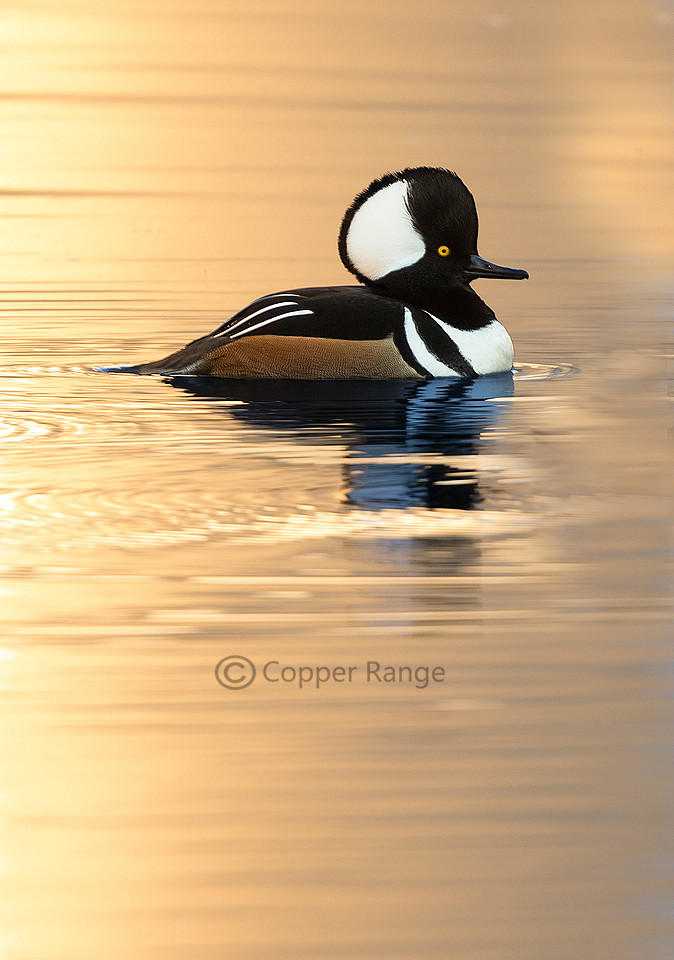
One of the most interesting things I first learned about ducks is that some species nest in tree cavities. Wood ducks, buffleheads, common mergansers, and hooded mergansers, and a few other species nest in tree cavities. Nesting in tree cavities offers protection from the elements and predators. However, the ducks don’t create their tree cavity nests, rather, they’ll occupy cavities created by other birds, including woodpeckers, and cavities that have naturally evolved. These same duck species that nest in tree cavities may also use human-built nest boxes placed along the edge of a water body or wetland. You might ask – how old are ducklings when they fly out of these tree cavity nests? In the case of wood ducklings and merganser ducklings they leave the nest 24 hours after hatching. Moreover, there’s no flying from the nest – they jump out -- and if all goes well with the jump, they follow their mother (hen) as she guides them to the nearest water. Just after hatching, a hen may lead her ducklings up to a half mile or more over land to find a suitable water source for swimming and feeding. As you might imaging jumping out of the nest and then traveling over land when you’re a day old means not all ducklings survive. Tree cavity nests can be quite high off the ground and may not be very close to water. With that said, if your timing is right and you’ve spotted a duck nest in a tree cavity, you might capture some stunning photographs of ducklings making their first entrance into the world. A couple of my favorite images of wood ducks, common and hooded mergansers and bufflehead ducks, all tree cavity nesters, follow.


Other duck species, including the canvasbacks, ruddy ducks, greater scaup, ring-necked ducks, redheads, and occasionally mallards, make their nests over water on “rafts” of floating vegetation. This strategy provides a measure of protection from land-based predators, like racoons, coyotes, foxes, or and even cats and dogs. A little spotlight on the Canvasback -- which is sometimes called "King Can" because of their aristocratic profile, but also because they’re the largest species of diving duck in North America. Canvasbacks are one of the fastest flying ducks in North America, capable of flying at least 60 mph (96 km/h). Like many ducks, Canvasbacks nest in very northern parts of the US and Canada, and migrate to warmer locations for winter. I live near one of the three US regions that the Canvasback overwinters – the Chesapeake Bay – and where the fetching chap’s photo below was taken last week. ️The two other US regions where Canvasbacks are known to overwinter is along the Pacific coast and in coastal Louisiana. Canvasbacks are heavily dependent on healthy watersheds and wetlands because they spend nearly all their time in the water. I love this quote about the King Can --- “May we always have the opportunity to meet these legendary birds up close and personal! This shall be so only if we look after the wetlands that sustain canvasbacks across our continent. Like a flight of cans arrowing through an autumn sky, our course is clear. Let us not fail the birds, or future generations, in our resolve.” Images of the beautiful canvasback duck, greater scaup and lesser scaup follow.


From a distance if you see a Northern Shoveler you might mistake it for a Mallard because they both have beautiful green heads. But a close look will reveal a big difference which is the shape and length of a Shoveler’s beak -- that’s where they get their name. Northern Shoveler’s have a large spoon-shaped bill with comb-like projections on the sides that they use to forage and filter out tiny crustaceans and seeds from the water. Northern Shovelers are ground nesting ducks as are Northern Pintails and Mallards.
Northern Pintails are considered to be widespread, though I’ve never seen them in large numbers, and each one I photograph is special. During their summer breeding season, the Pintail ranges from Alaska through Canada and into the Great Plains of the US. During the winter, it may be found in southern Alaska, nearly all regions of the interior US and all along the Atlantic Coast. This Pintail was photographed in a Virginia wetland during winter. Waterfowl management experts and advocates have concerns about declining Pintail populations. One factor in their decline is the destruction or alteration of the Prairie Pothole Region. This Region includes five upper Midwest US states (Minnesota, Iowa, North and South Dakota and Montana), and three Canadian provinces (Saskatchewan, Manitoba, and Alberta). Increased agricultural and commercial development in the Prairie Pothole Region has degraded or destroyed breeding and feeding grounds for Northern Pintails and many other North America migratory waterfowl. The US Great Plains and Prairie Pothole Region are No. 1 on the 25 most important and threatened waterfowl habitats on the continent.
Images of the Northern Shoveler, Northern Pintail, and Mallards follow.


Life is not easy as a duck. Those that make it are true survivors. Why is duck life hard? First, in most cases, within 24 hours of making their appearance into the world, ducks are essentially on their own, yet they can’t fly and are nearly defenseless. Second, humans can still legally hunt ducks, duck hunting is still incentivized as a conservation tool, and duck hunting remains somewhat popular. Financial support from duck and goose hunters has been a foundation of wetlands conservation ever since the federal duck stamp was first issued in 1934. Waterfowlers have contributed billions of dollars to wildlife management by purchasing duck stamps and hunting licenses, paying excise taxes on sporting arms and ammunition through the Federal Aid in Wildlife Restoration Act (Pittman-Robertson Act). And, a third reason duck life is hard is that humans have gotten into some bad, even if well-intentioned behavior, of feeding ducks unhealthy things like bread. Much has been written about this, leading some to call bread “the ultimate junk food for birds”. Bread is NOT for birds. See below for more information. Last, and not least, healthy wetlands, marshes and water, the natural habitats of ducks, are constantly under pressure from human development, encroachment, and pollution.
Sources and More Information:
https://www.audubon.org/news/how-build-wood-duck-nest-box
https://www.ducks.org/hunting/ducks-unlimited-and-hunting/ducks-habitat-and-hunters
https://www.thespruce.com/fun-facts-about-ducks-387094
https://www.audubon.org/atlantic-flyway#
https://www.thespruce.com/is-feeding-ducks-bread-bad-386564
https://www.wildlifecenter.org/problem-feeding-ducks
https://www.fws.gov/birds/management/flyways.php
https://www.nwf.org/Educational-Resources/Wildlife-Guide/Birds/Northern-Pintail
Our Responsibility to Work Toward A #betternormal - Taming the Monster in Our Closet
The pandemic of 2020 irrevocably changed our country and the world. It’s revealed ways we must change. The pandemic response laid bare the truth that we live in an unsustainable world. If nature was allowed to take its course during the pandemic; without shutdowns, closures, masks and social distancing, individuals, families, and health care systems would have been completely overwhelmed, unable to respond, and hundreds of thousands more would likely have died. While the pandemic showed that we live in an unsustainable world, it also showed the power of human resilience, innovation, ability to adapt and adjust our course, and that we are extraordinary problem solvers. That’s the theme for today – working toward a #betternormal with the power of human resilience, innovation, ability to adapt and adjust our course, and apply our extraordinary problem-solving skills.
We badly need a #betternormal in our consumption habits. How many of us know when we need to go on a diet or kick-up our exercise routine? Once our clothes no longer fit, or our medical tests reveal new health risks, or we just start to see and feel changes that aren’t working for us, we know change is needed. However, unlike weight gain, not everything that needs changing is easily seen. Our consumption habits -- specifically -- how much clothing we purchase is one of these. We’re badly in need of a #betternormal concerning our clothing consumption. Many of us have no idea how unsustainable our clothing consumption habits are.
Did you know?
- The consumption of clothing (and footwear) creates one of the biggest injuries to the planet, because most clothing is thrown away and ends up in landfills.
- Recent numbers show that in the United States, 70% of clothing (and footwear) was thrown away in landfills. That percentage is probably understated, because it doesn’t reflect clothes and fabric thrown away by the fashion industry before it gets to us consumers.
- The volume of clothing thrown away in the United States each year has doubled in the last 20 years, from 7 million to 14 million tons.
- The “Fast Fashion” model of some retailers is pushing out cheaper clothing, of lower quality, at very high rates, which contributes to the practice of buying and throwing away more clothing, continually adding burden to landfills and landfill space.
- The textile and clothing manufacturing process itself contributes to environmental degradation due to the amount of water needed in textile manufacturing, pesticides used to grow fabric materials (e.g., cotton), and other chemicals (nitrous oxide) used to produce nylon and polyester.
What You Can Do for A #betternormal
- Reduce Your Clothing Consumption-- Go on a clothes diet, and like any good diet, stick with it forever. Buy less; only buy when you really need it; and when you buy, look for retailers that sell recycled or previously worn clothing, like Patagonia’s Worn Wear, or ThredUp (read more next!)
- Buy Reused Clothing or Sell or Donate Your Used Clothing – Shop previously owned clothing. There are more options than ever to buy previously owned clothing and to also donate or sell the clothing that you no longer want or need. Spending just a few minutes on the internet to research your options could be a bonus payoff for you and the environment. You can shop at your local Goodwill or consignment shop. ThredUp is another on-line consignment and thrift shop with a huge selection of previously owned clothing. They have Gap to Gucci, including Lululemon, Anthropologie, Madewell and more. There’s also the earlier mentioned Patagonia’s Worn Wear program; Eileen Fischer also has a clothes buyback and resale program; Arc’teryx has a buyback and resale program; and others, including REI, are getting on board with this approach. Buying and selling used clothing, vs. new, can make a big difference. We do it with cars and now many ethically-minded retailers are finding ways to do it with clothes.
- Think Out of the Box -- Recycle or Repurpose the Clothes You Can’t Sell or Donate – Get creative. If you can’t resell or donate your clothes, recycle your clothes into something else instead of throwing them away. Old shirts, denim, and other clothing fabrics can be turned into functional or beautiful pieces. If you have an old shirt you love but no longer wear, think about making it into a decorative pillow cover, re-upholstering a chair, making cloth placements and napkins, or making a custom fabric wall hanging. Are you a crafter or know a crafter that uses a lot of plastic-based ribbon? Try a craft project using worn clothing or fabric scraps. Have a pair of well-worn jeans that are falling apart? You can turn them into a braided basket. There are other great on-line tutorials showing creative ways to give your clothing new life. Last, and no way least, don’t underestimate the value of turning your well-worn old clothes into rags. Anything can be a rag, and you’ll always need them. Rags can replace paper towels, which saves trees, and is a great win for the environment.
A lot of us may buy clothes only when we really need to. That's a habit to keep. But many others of us buy on a whim, impulse, out of boredom, the need for a "pick me up", because the sale was just too good to pass up, or because “it’s just SO cute.” Those habits have caught up with us and have created massive stress on the environment because most clothes end up in landfills. Natural resources are expended and polluted in the process of bringing us those 4 for $10 t-shirts that never get worn, or worn once and then get trashed. In the United States, we’re free to shop where we want and how much we want based on our own personal decisions. That freedom also comes with responsibility and opportunity to shop sustainably with an outlook on the well-being of our shared environment and its future.
Sources and More Information:
https://www.centerforecotechnology.org/fast-fashion-textile-waste/
https://compareethics.com/9-recycled-and-upcycled-clothing-brands-you-shouldnt-pass-in-2018/
https://www.epa.gov/sustainability/learn-about-sustainability#what
https://www.thegoodtrade.com/features/how-to-recycle-and-repurpose-clothing
https://wornwear.patagonia.com/
https://www.rei.com/used/how-it-works
https://www.thredup.com/#su-success
https://www.usedgear.arcteryx.com/about
https://www.nytimes.com/2019/09/03/books/review/how-fast-fashion-is-destroying-the-planet.html
https://www.centerforecotechnology.org/creative-reuse-upcycled-denim-basket/
https://www.lifehack.org/279725/give-new-life-old-clothes-these-8-quirky-ways
https://time.com/5923840/us-pandemic-relief-bill-december/
American Robin - Eating Like A Bird

Eating Like A Bird in winter. Robins are one bird you won’t normally see on a seed feeder. In the warmer seasons, they’re primarily eating worms and insects. In the colder seasons, they’re primarily eating berries. Many of us are pretty familiar with Robins because they’re widespread in North America. They frequent urban areas, backyards, as well as wild areas. Some Robins that breed in Canada come south to the United States for winter while other Robins go as far as Mexico for winter. We don’t always know or get to experience how intelligent birds are, but I have a Robin story to illustrate this. While I was watering our vegetable garden one summer morning, a female Robin hopped up on the garden fence and perched and watched me. She was about 4 feet away and just watched me. I've never seen that. After I finished watering one part of the garden, I moved down with my hose to a new part. As I did that, the Robin flew down to the area that was watered and, using only her beak, started to collect as much of the now muddy, damp soil as she could. She flew off and a few minutes later came back for more. I didn't see where she went, but I'm pretty certain she was collecting material for her nest. Robins use mud to reinforce the sticks and other material they construct their nests with.
What most impressed me is that the Robin showed up just as I turned the water on. It seemed she recognized, and had learned the sound of the water and what that would mean for where it was going. How much I wished I had a video of that smart Robin mom! Speaking of water, Robins also love a good bath. If you put clean bird baths out, they’ll be one of the first to bathe or drink, and they’ll come back often.
Because Robins forage a lot on lawns, they’re vulnerable to pesticide poisoning from lawn applied pesticides.
This is the final episode in my Eating Like A Bird series! I hope you’ve enjoyed this series; and it’s given you some new information, perspective, or inspiration about our many feathered friends.
Read More about the Eating Like A Bird series: https://www.copperrangellc.com/blog/2020/12/eating-like-a-bird
Raptors - Eating Like A Bird

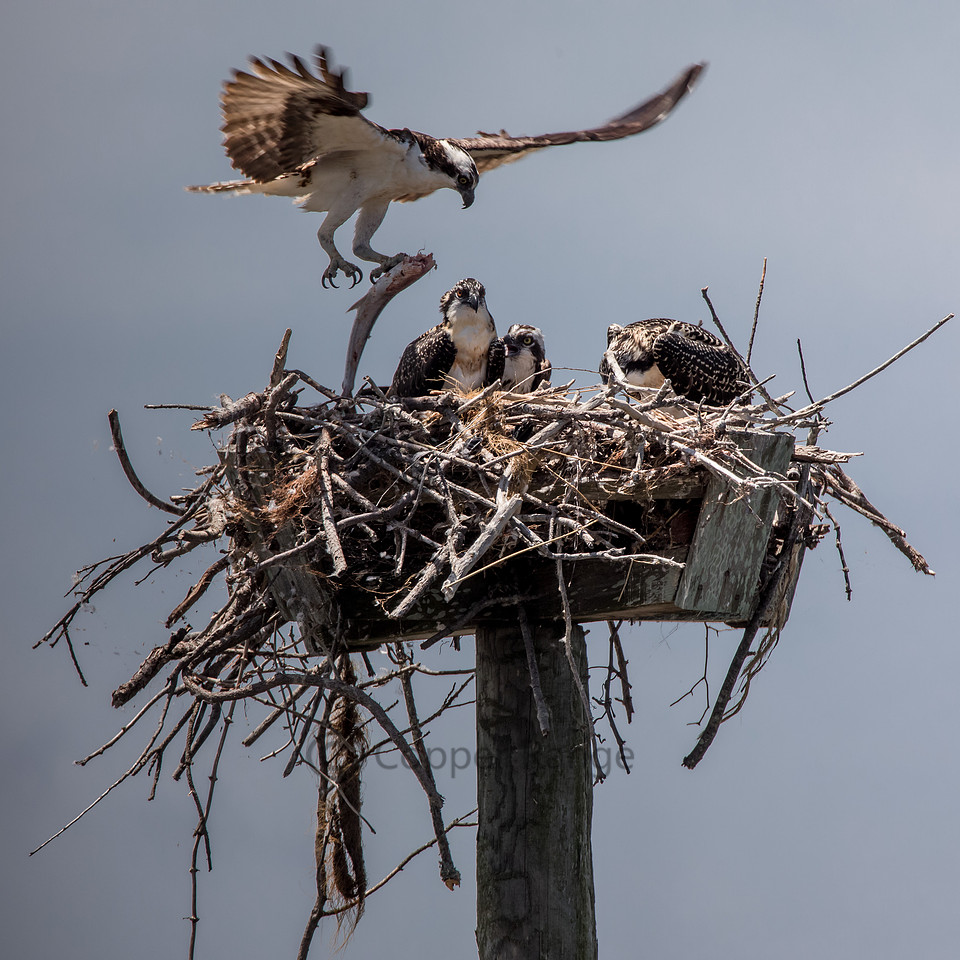
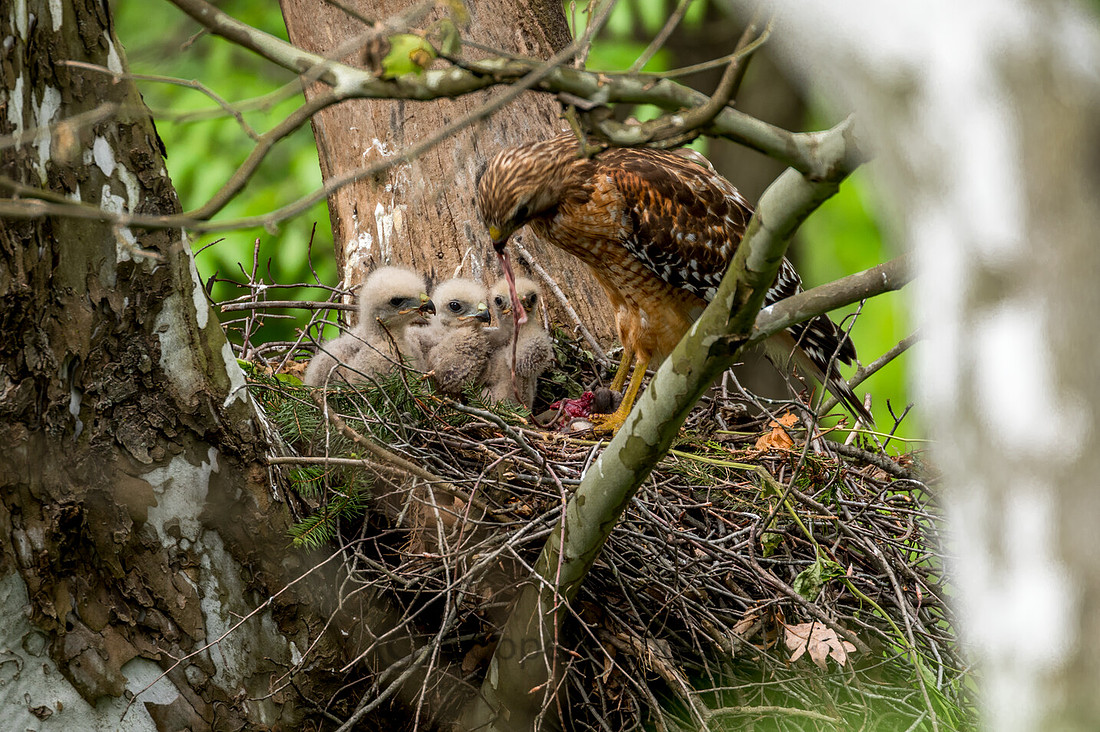
It may not be pretty, but it’s ok, its baby food. The three raptors shown here all had young in the nest, or fledglings that just left the nest, and were delivering or feeding food to their young babies. The Eating Like A Bird series, now enters the apex of the bird world -- raptors! Raptors, including owls, hawks, and osprey are birds of prey that feed on live caught prey, and sometimes dead animals. Three things set raptors apart from all other birds, (1) strong grasping feet with sharp talons used to seize prey; (2) a hooked beak used to kill and rip prey apart and, (3) typically a meat-only diet (some hawks and falcons are known to eat insects). Scroll through -- Photo 1 is a Barred Owl photographed in Virginia after it captured a live snake; photo 2 is an Osprey parent delivering fresh caught fish to its young, and its mate, photographed in North Carolina, and photo 3 is a Red Shouldered Hawk parent feeding a small animal to its young, photographed in Washington, DC. Yeah, I’m not a fan of watching anything be eaten alive, but raising babies happens in nature too. Some of the hazards these adult and young raptors face in their lifetimes include pollutants in fish and fishing waters, chemically-poisoned prey, habitat loss, and other human-caused actions including vehicle collisions and gunshots.
Here’s a few facts about Barred Owls and Osprey. See my extensive blog on Red-shouldered Hawks for lots of facts about them, https://www.copperrangellc.com/blog/2020/4/red-shouldered-hawk-nest. Barred Owls are native to North America and fairly widespread. Like many raptors, Barred Owls have exceptional vision and hearing, and are widely successful at catching prey. Although owls are skilled nighttime hunters, they also hunt in the day. Barred Owls have traits that help them be successful night hunters. First, they have very large eyes. Owl eyes can be as much as 3% of their body weight. Not only are Barred Owl eyes very large, they’re also forward facing and provide “binocular” vision which provides better depth perception to detect prey. Larger eyes also capture more light at night, allowing for better night vision. Second, although Barred Owls can’t move their eyes in the socket (like humans can), they can turn their heads around 270 degrees in both directions, giving them great field of view.
Barred Owls preferred habitat is old deciduous and coniferous forests close to swamps or marshes. They nest in empty tree cavities or in the abandoned nests of other birds. Their nests are usually lined with a layer of soft feathers. Barred Owls don’t migrate and they usually don’t venture beyond their territory unless food is scarce. In its lifetime, Barred Owls may move no more than 6 miles from its original location. It’s becoming more usual to see Barred Owls living near or in urban and residential areas. This could be due to easier availability of squirrels, rabbits and other rodents, such as mice and rats. The Barred Owl gets its name from the bars of white and brown colors on its body. It has brown eyes, unlike the yellow or orange eyes of other owl species, including Snowy, Great Gray, and Great Horned Owls.
Osprey are hawks that feed primarily on fish which they catch from the water using their long, hooked talons. Ospreys live on every continent except Antarctica and they have a very similar appearance regardless of where they live. Most Ospreys are migratory birds that breed in the north and migrate south for the winter, but not all populations don’t migrate. It’s really something to watch an Osprey hunt and catch fish. An Osprey can plunge so forcefully into the water that it completely submerges. With that said, Osprey can only dive about three feet below the water's surface so they gravitate toward shallow fishing grounds, going into deep water only where schools of fish are near the surface. When carrying prey back to the nest, Osprey will arrange a fish so that’s its facing upright, head forward. Occasionally, an Osprey will catch and eat a snake, eel, or even a frog. Ospreys require nest sites in open surroundings for easy approach, with a wide, sturdy base and safety from ground predators. Nests are usually built on snags (dead trees), treetops, or forks between large branches and trunks; on cliffs or human-built platforms. Osprey differ in several respects from other diurnal birds of prey (raptors that hunt during day). Specifically, its toes are of equal length, its tarsi are reticulate, and its talons are rounded, rather than grooved. Osprey and Owls are the only raptors whose outer toe is reversible, allowing them to grasp their prey with two toes in front and two behind. This is particularly helpful when they grab slippery fish. Osprey also have two other adaptations for their environment: (1) they can close their nostrils to prevent water going in when they dive for fish, and (2) they have dark bands around their eyes, which help reduce the sun’s glare when they scan the water for fish.
Read More about the Eating Like A Bird series: https://www.copperrangellc.com/blog/2020/12/eating-like-a-bird
More information:
https://tetonraptorcenter.org/our-work/education/all-about-raptors/
https://www.wildlifecenter.org/episode-four-owls
Hummingbirds - Eating Like A Bird

A more relaxing approach to getting a meal. There are few birds more captivating than hummingbirds. Their speed, beauty, stamina, and survivability are just so impressive and magical. I also think their tiny feet are incredibly cute. Hummingbirds are the smallest bird species. Ruby-throated hummingbirds, like the one pictured, weigh about the equivalent of a US nickel (other species are even smaller), so perching on a flower stem to collect some nectar – that’s doable for a hummingbird. Eating Like A Bird in this case looks a lot more leisurely than a hummingbird’s usual hovering style. That doesn’t mean it was any less leisurely for me to get this shot when it was taken this past summer! Hummingbirds don’t stay still for long out in the open.They have a very high metabolism and have to eat all day long just to survive. They consume about half their body weight in bugs and nectar, feeding every 10-15 minutes. Hummingbirds eat small insects, beetles, ants, aphids, gnats, mosquitoes, and wasp. We're always learning about these birds. As I write this blog post during winter, birding groups in my area have reported seeing a live, and apparently well, Rufous Hummingbird in Northern Virginia. We've already experienced snow and below freezing temperatures in the region, so that is a testament to the survivability of some hummingbirds.
See my additional blog post on Hummingbirds here: https://www.copperrangellc.com/blog/2020/7/the-spirit-of-a-fallen-warrior-a-new-year-with-the-wonders-of-hummingbirds
Read more about this blog here: https://www.copperrangellc.com/blog/2020/12/eating-like-a-bird.
Gray Catbird - Eating Like A Bird

Don’t underestimate Catbirds. Like many migratory bird species, if you have Catbirds in your area, and your habitat is good for them, they may loyally return year after year. Catbirds are seen in large parts of North America and coastal areas of Central America.This Catbird grabbed some insects in the grass from a driveway reflector used as a perch. Eating Like A Bird -- whatever works.
Migration of Catbirds has been studied and documented through bird-banding and geolocator research which has revealed fascinating facts about the movement of Catbirds. The geo-tracking science tells us that if a Catbird breeds, or spends its spring/summer in the Midwest US, it probably winters in Central America. If it breeds in the US Mid-Atlantic region, it probably winters in Florida or the Caribbean. That means this neighborhood Catbird I photographed this past summer probably spent the winter in Florida or the Caribbean – strong and smart!
Catbirds eat insects; and they love peanuts and berries. The Conservation and Biology Institute at the Smithsonian National Zoo in Washington, DC has an ongoing study of Gray Catbirds to better understand this common migratory bird that breeds in human-dominated urban and suburban landscapes. Birds are being tagged in the greater Washington, D.C., area, Massachusetts, Georgia and Colorado to better understand how diverse breeding habitats (including urban environments) influence when birds leave, where they stop and where they winter on their long migratory journeys. The birds are banded and tagged with lightweight GPS backpacks that take highly accurate points throughout winter and during fall and spring migration.
Catbirds get their name from their vocalizations, which can be numerous, but sometimes sound like a cat. Because Catbirds are often urban birds, the human noises they’re exposed to such as traffic, construction and ringing cell phones, shape the acoustic environment and may impact the effectiveness of courtship songs of males and the signals preferred by females.
Read more about this blog here: https://www.copperrangellc.com/blog/2020/12/eating-like-a-bird.
More information:
https://nationalzoo.si.edu/migratory-birds/gray-catbirds
Yellowthroat Warbler - Eating Like A Bird
 Bring on the BugsImmature Male Yellowthroat with Cucumber Beetle. Northern Maryland
Yellowthroats are vocal birds, and their often-uninterrupted calls and chirps help reveal their presence. But once you’ve seen them, don’t assume you’ll see them again or you can get your camera to focus on them. These are fast moving small birds that forage in dense vegetation, shrubs, and thickets. This is an immature male yellowthroat that captured a cucumber beetle. Cucumber beetles, also known as southern corn rootworm, are a major agricultural pest in North America. Because of the subterranean nature of their larvae, these insects are hard and expensive to control, so Eating Like A Bird in this case is a nature-designed pesticide. Adult male yellowthroats have a bright yellow body and black mask and are very striking birds. The black mask is an important signal for male birds. When researchers added a black paper mask to a stuffed female, males started attacking the stuffed bird, as if it were a male rival. Yellowthroats are found in most of North and Central America. Most yellowthroat populations migrate with some flying short distances and others go all the way from northern Canada to Central America. Like all wild birds, yellowthroats rely on healthy habitats for survival. Because yellowthroats are insectivores and often live in wetlands, they’re susceptible to poor water quality, pesticides, other pollutants, and declining wild habitat.
Read more about this blog here: https://www.copperrangellc.com/blog/2020/12/eating-like-a-bird.
Herons - Eating Like A Bird


Herons and Egrets belong to the same family (Ardiedae). These wading birds are common to many of us because they’ve become pretty tolerant of humans. Even in populated areas that have good wetland, pond or lake habitats it’s not unusual to see a great blue heron standing quietly looking for a catch. For wildlife and bird photographers, herons and egrets can be such common sightings that we begin to take them for granted and move on to other more “exciting” things. Though when we do that, we can miss the most exciting and educational moments when they make a catch. In this series of Eating Like a Bird, I share photographs of a Great Blue Heron with a large snake catch, a Green Heron –which aren’t as easy to see in the wild – with a crayfish, and an Egret with a bullfrog. These are exciting events to witness and capture.
Herons and Egrets are very skilled and powerful hunters that depend on healthy wetland and water habitat for their survival. The Green Heron is one of the world’s few tool-using bird species. It often creates fishing lures with bread crusts, insects, and feathers, dropping them on the surface of the water to entice small fish. Great Blue Herons also forage in grasslands and agricultural fields. Great Blues may eat small mammals such as rabbits and birds including ducklings. Some of the continuing risks herons face include disappearing habitat due to human development and expansion, and injuries or death due to carelessly discarded fishing line. One of the things I’ve learned from watching herons is that patience and work pays off. Often, these birds stand and watch for hours and then it seems, out of nowhere, they pull up a frog, a fish, or another amazing catch.
Read more about this blog here: https://www.copperrangellc.com/blog/2020/12/eating-like-a-bird.
